Stop Reporting the Average Response Time
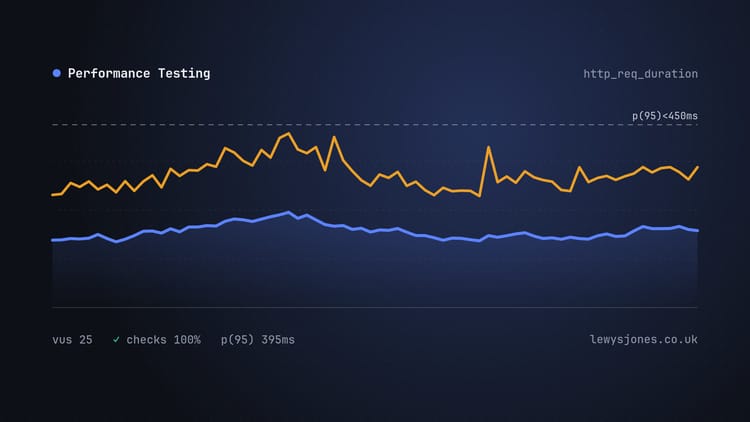
The average is the easiest number to put in a report and one of the least useful. Here's what I look at instead, and how to get k6 to show it.
Performance testing · k6 · Quality engineering
Insights, stories and ideas on performance testing
Series · 7 parts
Free tools
Writing
The average is the easiest number to put in a report and one of the least useful. Here's what I look at instead, and how to get k6 to show it.
One of the ongoing challenges is generating realistic and varied test data, especially when simulating large numbers of users. Manually creating this data can be both time-consuming and prone…
Software development is constantly adapting, with performance testing at the forefront of ensuring seamless user experiences and system stability. Observability emerges as a pivotal enhancement, offering a nuanced approach to…
In a world increasingly driven by technology, the field of performance testing is often perceived through the lens of codes, scripts, and metrics. However, behind every successful project, there lies…
When it comes to performance testing, there's a belief that it should mimic the production environment as closely as possible. While this stands true in many aspects, there&…
Setting up a proper environment for performance testing is a critical step in ensuring your software application can withstand various loads and provide a seamless user experience. To avoid inaccurate…
Welcome to part six of my blog series on using k6 to test the performance of PokeAPI! I will cover integrating k6 tests into a Continuous Integration (CI) pipeline to…
I promise I'm not a Pokémon enthusiast, but the PokeAPI is just a good playground for testing and learning about APIs, with that let me try to show…
At the risk of becoming a broken record; Performance testing is critical to ensure that software applications meet the expectations of users in terms of responsiveness, stability, and throughput. To…
Welcome back to my blog series on using k6 to test the performance of PokeAPI! Part 5! Even I'm a little surprised I've kept this up,…
Welcome back to my blog series on using k6 to test the performance of PokeAPI! In this fourth instalment, I'll introduce the concept of assertions and their importance…
Welcome back to my blog series on using k6 to test the performance of PokeAPI! In this third instalment, I'll discuss different test scenarios, such as load testing,…
Browse